Kitchen design for Kerala homes: a show kitchen and a work kitchen.
7 min readBy Homlum Architecture
Good kitchen design for Kerala homes starts with an honest look at how the family cooks. Fish fried in coconut oil, mustard seeds spluttering in hot oil, batter ground for appam and dosa, rice cooked in large vessels: this is cooking that makes smoke, grease and steam every day. This guide explains why many homes now split the kitchen in two, and how to plan the work area, storage, ventilation, counters and finishes so the kitchen still looks good years later.
Why many Kerala homes have two kitchens.
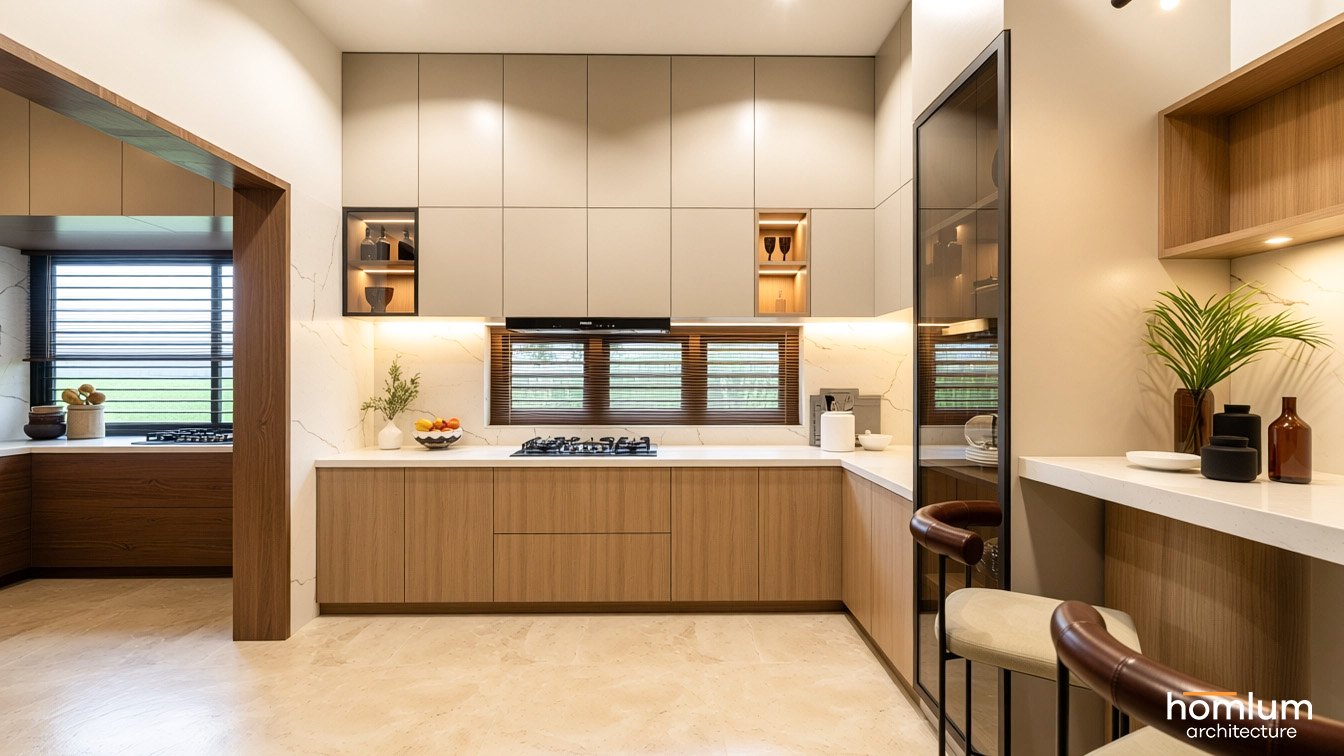
A show kitchen is the clean, open kitchen near the dining area. It is where you make tea, warm food, prepare breakfast and talk to guests. It often has an island or a breakfast counter, closed cabinets and good-looking finishes.
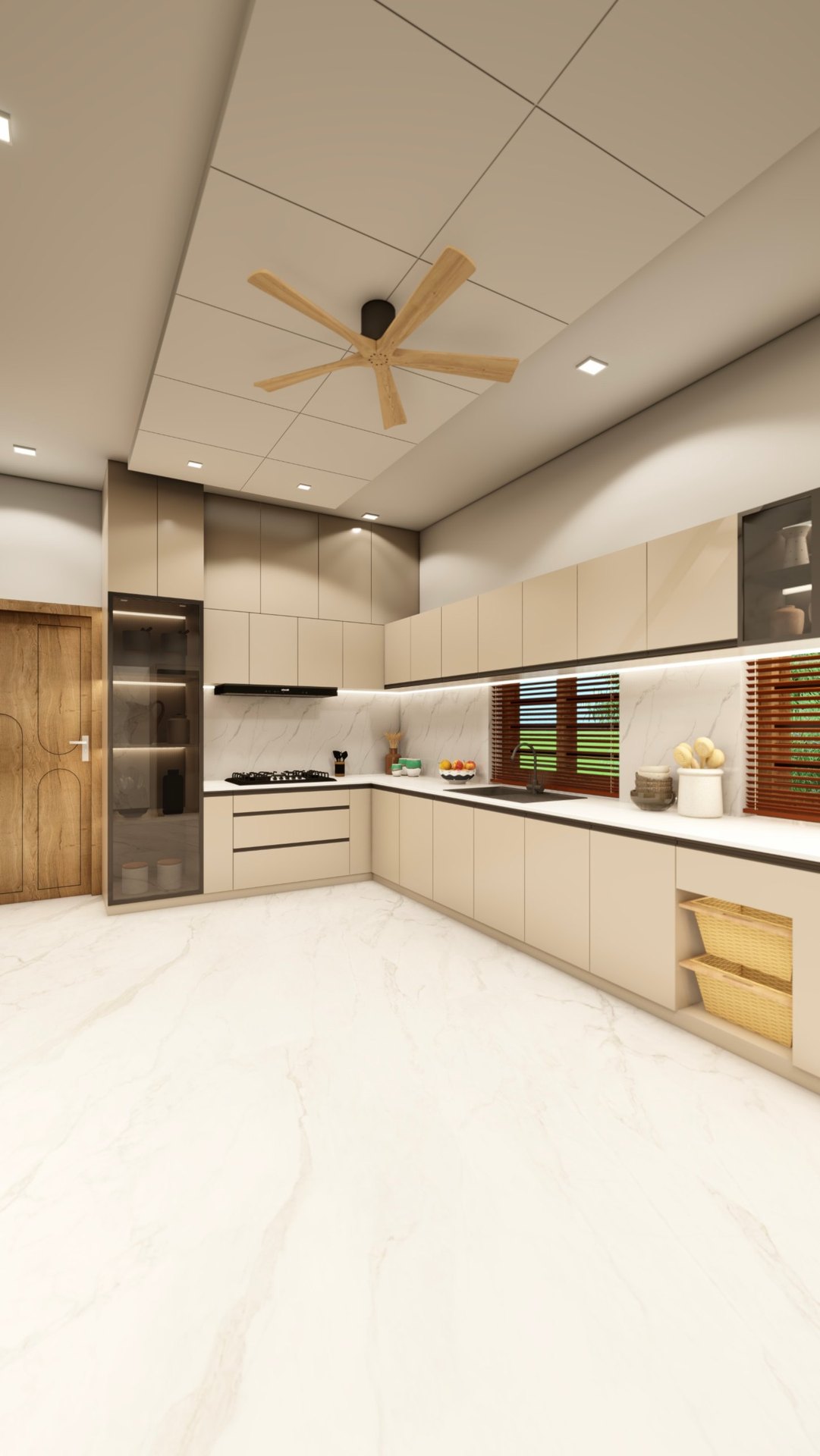
The work kitchen, often just called the work area, sits behind it. This is where the heavy cooking, frying, grinding and washing of large vessels happens. It may hold a second stove, the wet grinder, a deep sink, drying racks and sometimes a wood-fired stove for slow cooking.
The split works because it keeps smoke and mess in one room while the room people see stays calm. It suits joint families, homes that host large gatherings and households where more than one person cooks at a time. In a smaller house the same idea can be scaled down to a utility corner with a sink and a second hob, separated from the main kitchen by a door or a glazed partition.
Planning the work kitchen around how you cook.
Before choosing any cabinet, list what actually happens in your kitchen in a normal week. Ask your designer to plan from that list rather than from a catalogue picture.
- Where is fish cleaned, and where does the waste go?
- How many people cook at once, and do they need separate stoves?
- Which appliances stay on the counter all day: mixer grinder, wet grinder, rice cooker, pressure cooker?
- How large are the biggest vessels, and where will they be washed and dried?
- Is coconut scraped at home, and is there space for it?
The classic work triangle between sink, stove and fridge still helps, but in a two-kitchen house it often makes sense to put the main sink and the main stove in the work area and keep only a small sink in the show kitchen. A door from the work area to the outside, to a drying yard or a service passage, is very useful for waste, gas cylinders and washing large vessels.
Plan plug points generously and at the right height, with dedicated points for the grinder, oven and any water purifier. Moving a point after tiling is messy and expensive.
Smoke, grease and ventilation.
Ventilation matters more than any finish. Oil smoke that is not taken out of the house settles on cabinets, ceilings and fans, and turns into a sticky film.
- Fit a chimney or hood that is ducted to the outside, not one that only recirculates. Keep the duct short and straight, with as few bends as possible.
- Place the stove on or near an external wall so the duct can leave the house directly.
- Add an exhaust fan high on an outer wall in the work area, where hot air collects.
- Give the kitchen windows on two sides where the plan allows, so air can move through. Our guide to natural ventilation in a tropical home explains how cross-ventilation works.
- Keep the gas cylinder in a ventilated, accessible place and follow your gas supplier's safety guidance on piping and placement.
A window over the sink is worth fighting for. It brings in daylight, lets steam out and makes washing up far more pleasant.
Plan the kitchen around the messiest thing you cook, not around the photograph you want of it.
Storage that matches a Kerala pantry.
Kerala kitchens store a lot of bulk food and a lot of steel. Plan storage around that.
A tall pantry unit or a small walk-in store keeps rice, flour, pulses and spices together. Deep drawers suit heavy steel vessels and pressure cookers far better than shelves behind doors, because you can see everything without kneeling. A slim pull-out next to the stove keeps oil, salt and spice tins within reach.
Give the mixer and grinder a home with a plug point, so they are not moved every day. In the show kitchen, an appliance cabinet with a lifting or sliding shutter hides the kettle and toaster. Keep the area under the sink open at the back or use moisture-proof materials there, because small leaks are common and slow to notice.
Where wall cabinets go up to the ceiling, use the top row for things you rarely need.
Counters, cabinets and finishes that cope.
Kerala's humidity and monsoon damp are hard on kitchen materials. Choose for the climate and for daily cleaning, not only for looks.
- Counters. Granite is hard and copes well with heat, oil and turmeric. Quartz is consistent and low-maintenance, though very hot vessels should go on a stand. Marble looks beautiful, as in the backsplash here, but it is softer and can be etched by tamarind, lime and vinegar, so it suits a backsplash or a show kitchen better than a heavy work counter, and it needs sealing.
- Cabinet carcasses. Ask for waterproof-grade plywood or a board suited to wet areas, especially near the sink, and get the grade written in the quotation. Our article on modular or site-made furniture explains boards and grades in more detail.
- Shutters. Laminates and matt finishes hide fingerprints and grease better than high gloss. Edges must be sealed well, because moisture enters through raw edges.
- Walls and floors. Use tiles or another washable surface behind the stove and sink. Choose a matt, slip-resistant floor tile, since kitchen floors get wet and oily.
- Hardware. Stainless steel or well-coated hinges and channels resist rust, which matters near the coast where the air carries salt.
Good light finishes the job. Strip lights under the wall cabinets light the counter without shadows, and our guide to planning light in a home covers task lighting and switching.
Common questions.
What is a work area in a Kerala kitchen?
A work area is a second, more practical kitchen behind the main one. It handles heavy cooking, grinding, washing large vessels and storage, so the main kitchen stays clean. It usually has its own sink, a stove and good ventilation, and often a door to the outside.
Is a kitchen chimney necessary for Indian cooking?
For cooking with a lot of frying and tempering, a ducted chimney makes a real difference to how clean the kitchen and the rest of the house stay. It works best when the duct runs a short distance straight to the outside. An exhaust fan and cross-ventilation help as well.
Which countertop is best for a Kerala kitchen?
Granite is a common choice for work counters because it handles heat, oil and stains well. Quartz is a good low-maintenance option. Marble can be lovely in a show kitchen or as a backsplash, but it needs sealing and care around acidic food.
Do I need a separate work kitchen in a small house?
Not always. A compact utility space with a sink, a second hob and an exhaust fan, behind a door, can give you most of the benefit. Your designer can show you how much space it takes in your plan.
If you are planning a new kitchen or reworking an old one, talk to us about how your household cooks and we can start from there.