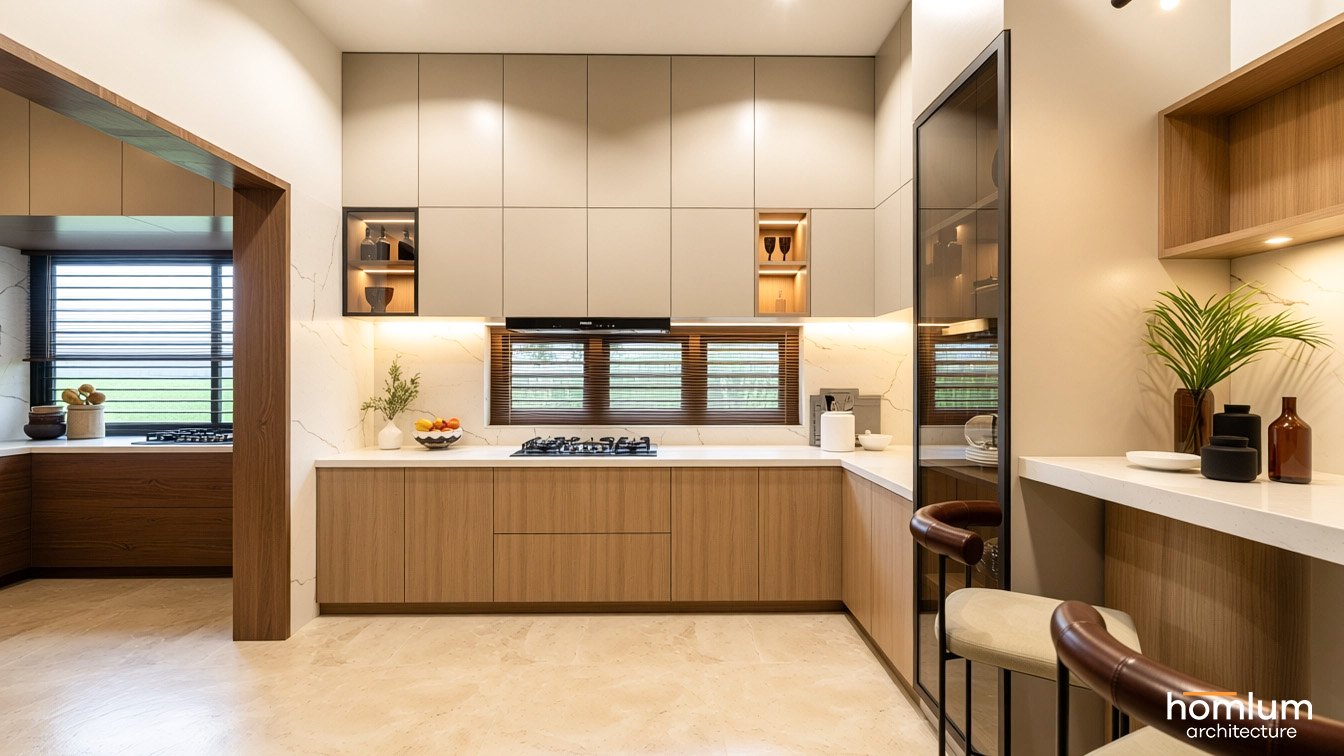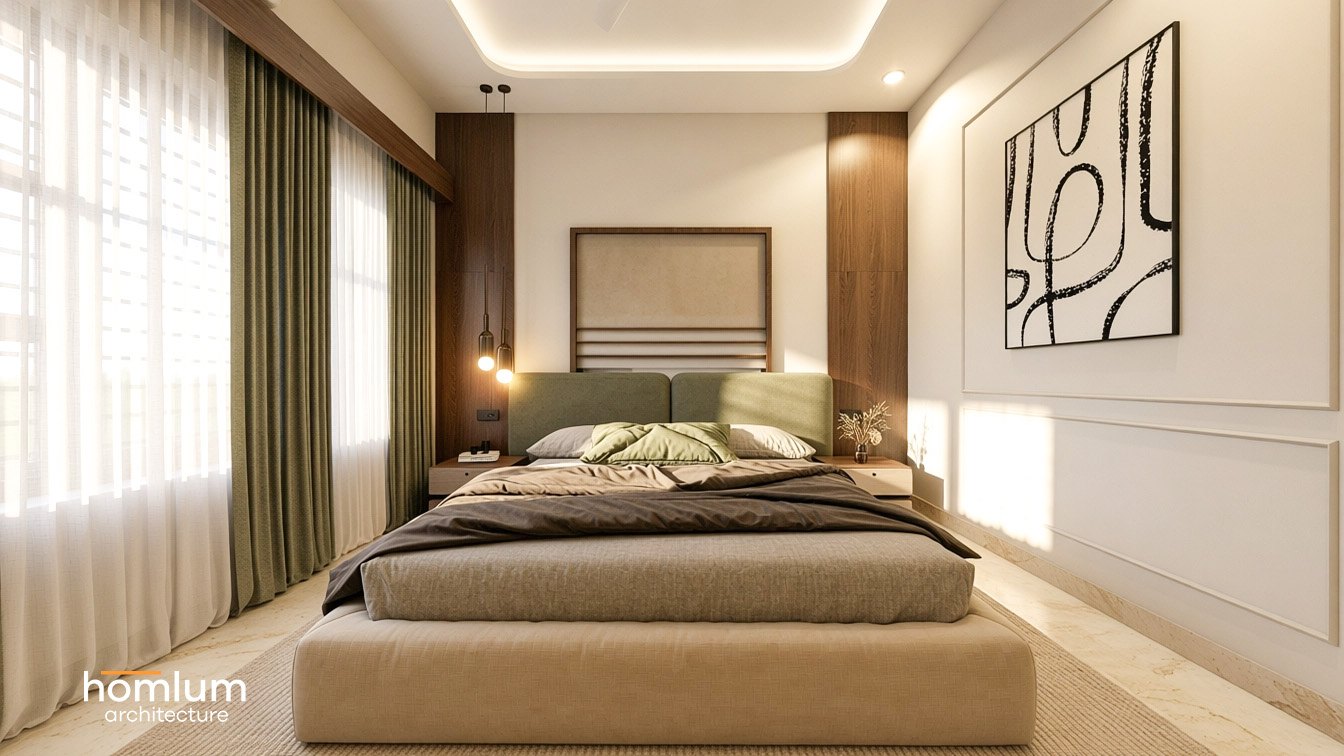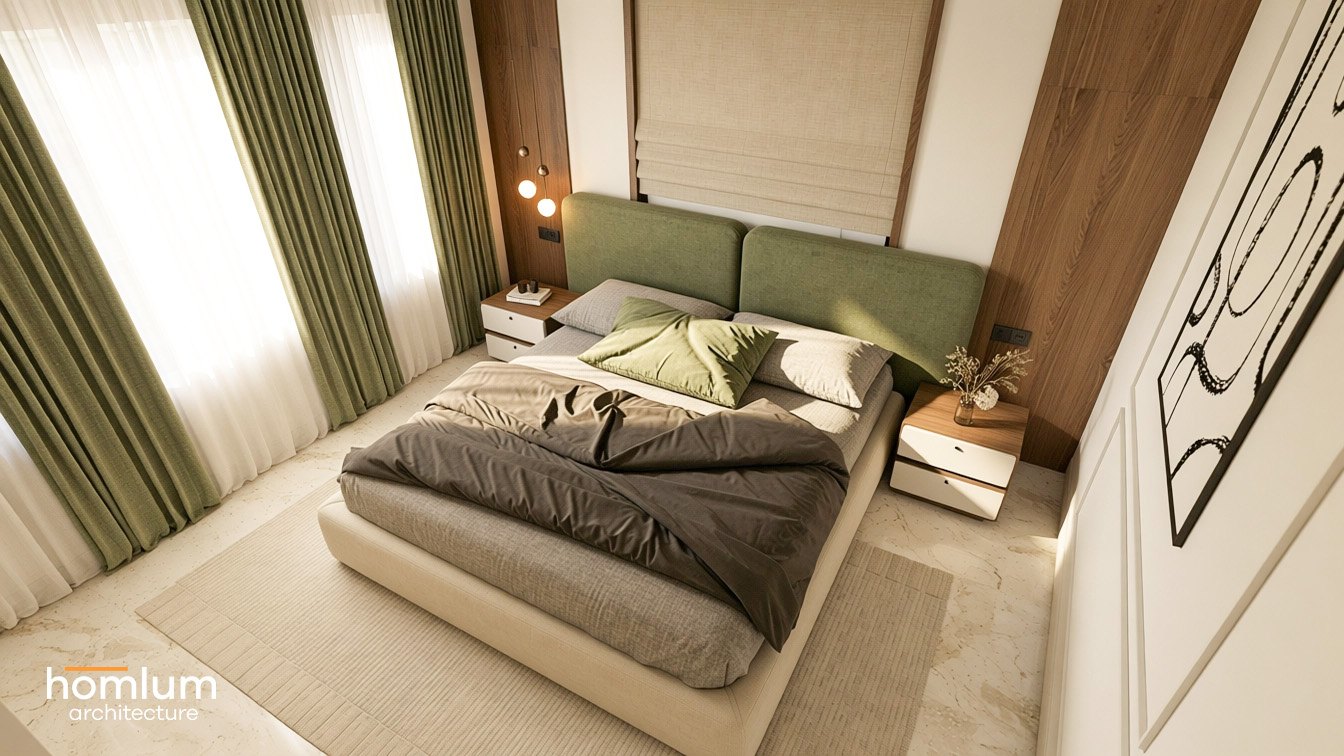
Modular or site-made furniture: which suits your home.
7 min readBy Homlum Architecture
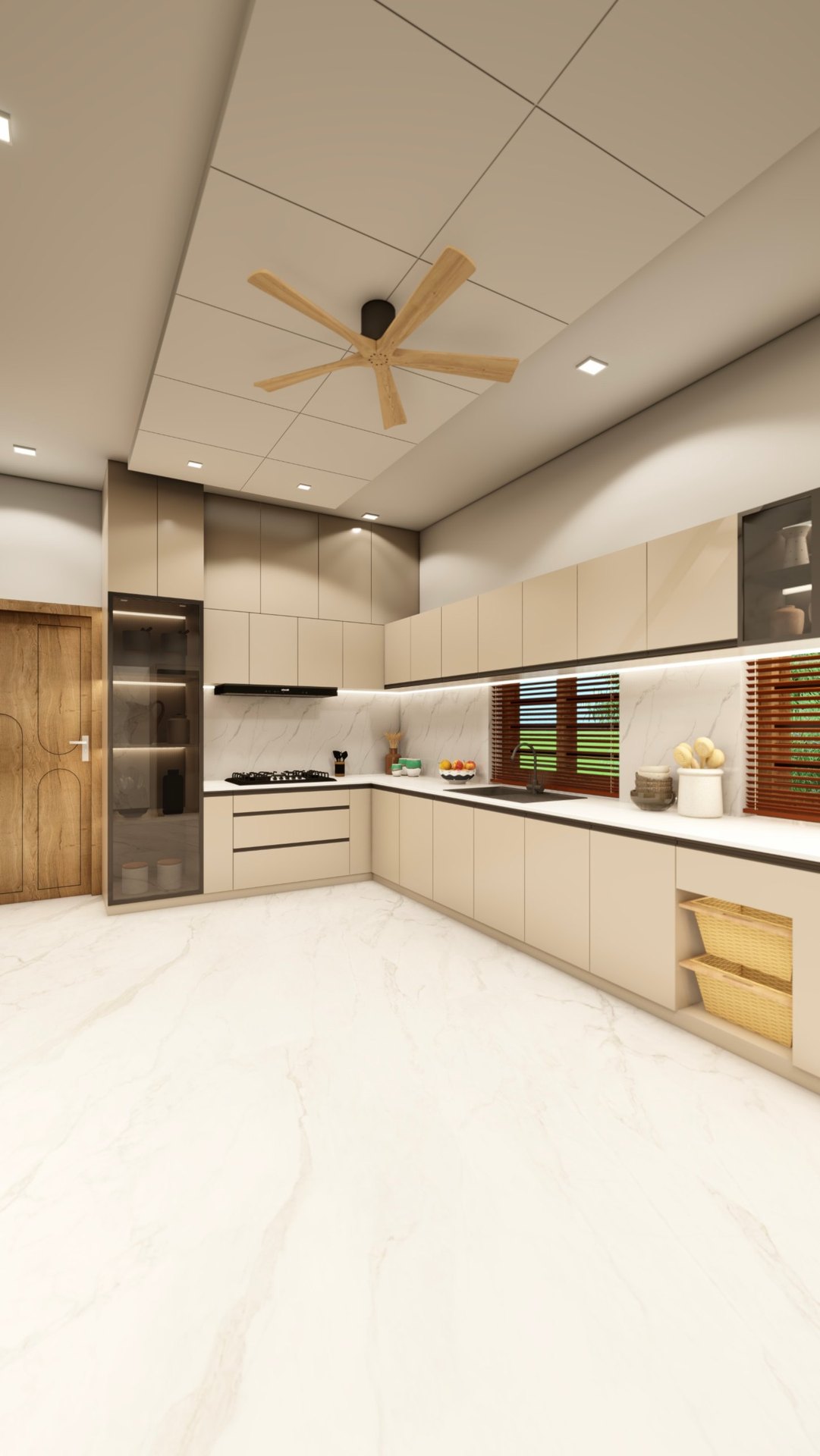
Choosing between modular or site-made furniture is one of the first practical decisions in any interior project. Both can give you a good kitchen or wardrobe, and both can go badly wrong. This guide explains what each really means, which boards and finishes suit Kerala's humidity, how hardware, timelines and warranties differ, and what drives the cost, so you can decide room by room.
What modular and site-made furniture actually mean.
Modular furniture is made in a factory. Panels are cut, drilled and edge-banded by machine, then delivered and assembled on site. Cabinets are built from standard units, with fillers and end panels used to fit them into the room.
Site-made furniture is built in your home by a carpenter. Boards are bought, cut and finished on site to fit the exact walls and openings.
In practice many homes use both. A kitchen and wardrobes may be modular, while a bed wall, a pooja unit, a staircase cabinet or an awkward corner is made on site. Here is how they usually compare:
- Precision. Modular units are cut by machine, so joints and edges are consistent. Site-made work depends on the carpenter's skill and tools.
- Fit. Site-made furniture can follow any wall, slope or odd corner. Modular units fit best in rooms that are square and accurately built.
- Design freedom. Site-made work can take any shape or detail. Modular systems are more limited, though most makers offer a wide range.
- Time on site. Modular furniture spends most of its time in the factory and is installed quickly. Site-made work keeps the house busy, dusty and noisy for longer.
- Moving house. Modular units can often be taken apart and refitted, with some loss. Site-made pieces are usually built in for good.
Plywood, boards and grades.
The board inside the furniture matters more than the finish on the outside, especially in Kerala. You will usually be offered some of these:
- Plywood is made from thin layers of timber veneer glued together. It comes in different grades, often sold as moisture-resistant (MR) for dry areas, and boiling-water-resistant (BWR) or boiling-water-proof (BWP), sometimes called marine grade, for wet ones.
- MDF (medium-density fibreboard) is smooth and good for painted or routed shutters, but it swells if water gets in.
- HDHMR and similar high-density boards are made to resist moisture better than standard MDF, and many modular makers use them for shutters.
- Particle board is the most economical but the least tolerant of moisture, so it is best kept well away from sinks and bathrooms.
Whichever you choose, ask for the board type, grade and brand to be written into the quotation for each item. Kitchen bases, sink units and bathroom vanities need the most water-tolerant board. Our article on kitchen design for Kerala homes explains where the wet zones are.
In Kerala, the board inside the cabinet and how well its edges are sealed matter more than the finish you see.
Finishes and humidity in Kerala.
Kerala's long humid seasons are hard on furniture. Moisture enters boards through raw or poorly sealed edges, hinge holes and the back panel, not usually through the face. That is why edge banding, well-sealed cut-outs and a gap behind cabinets on external walls matter so much.
Common finishes include laminate, veneer, acrylic, lacquer or PU paint, and membrane. Laminate is tough and easy to clean. Veneer gives real timber grain but needs a good polish and some care. High-gloss acrylic and PU look striking but show scratches and fingerprints. Factory-applied finishes are usually more even than finishes sprayed or brushed on site, where dust and humidity can affect curing.
Termites are a real concern in many parts of the state. Ask whether the board is treated against borers and termites, and make sure the walls and floor behind built-in units are protected too. Our guides to materials for a humid climate and damp and termite protection cover the building side.
Hardware, fit and timelines.
Hinges, drawer channels, lift-up fittings and handles take the daily wear. Branded hardware with soft-close action costs more but usually lasts far longer. Near the coast, salty air can rust cheap fittings quickly, so ask for stainless steel or well-coated hardware. As with boards, have the hardware brand and model written into the quotation, item by item.
Timelines differ in shape more than in total length. Modular furniture needs final site measurements after the flooring, wall tiling and plastering are complete, followed by production in the factory and then installation. Site-made furniture can start earlier, but it takes longer on site and often overlaps with painting and other trades. In both cases, late design changes and incomplete civil work are the most common causes of delay.
What drives the cost and what the warranty covers.
There is no single answer to which is cheaper. The cost of either depends on:
- The board type and grade.
- The finish on the shutters and visible sides.
- The hardware brand and the number of drawers, lift-ups and internal fittings.
- How much is custom rather than standard size.
- Transport, installation and any site modifications.
Drawers generally cost more than shelves behind doors, and special fittings such as corner carousels and tall pull-outs add up quickly. Ask for itemised estimates that list each unit with its dimensions, board, finish and hardware, so you can compare offers fairly.
Warranties also vary. A modular maker may offer a written warranty on boards and hardware, but read what it covers and what it excludes, such as water damage. A carpenter's work may have no formal warranty at all, which makes the materials and the carpenter's track record more important. In either case, ask who will come back to adjust hinges and fix problems after the first monsoon. For how this fits into the wider project, see our guide to how an interior design project works.
Common questions.
Is modular furniture better than carpenter-made?
Neither is better in every case. Modular furniture gives consistent factory finishing and quicker installation, while site-made work fits unusual spaces and allows more design freedom. Many homes use modular for kitchens and wardrobes and site-made for one-off pieces.
Which plywood is best for kitchen cabinets in Kerala?
For the sink unit and other wet areas, ask for a boiling-water-resistant or boiling-water-proof grade, from a brand you can verify. Drier wall cabinets can use a moisture-resistant grade. Whatever you choose, make sure the grade is written in your quotation.
Does modular furniture last in humid weather?
It can last well if the boards suit the location, all edges are sealed and the hardware resists rust. Problems usually start at unsealed edges, around the sink and on cabinets fixed to damp external walls.
Can modular furniture be moved to a new house?
Often, yes, because it is assembled rather than built in. Expect some units not to fit the new rooms and some panels to need replacing. Site-made furniture is usually much harder to move.
If you are weighing up modular and site-made furniture for your home, talk to us and we can look at each room with you.