Designing a café or restaurant interior that works.
7 min readBy Homlum Architecture
A café or restaurant has to look good, but it also has to work hard every day: serve people quickly, keep staff moving, survive spills and monsoon humidity, and make guests want to come back. Good café and restaurant interior design in Kerala balances all of this from the first sketch. This guide covers concept and brand, seating layout and flow, the kitchen and service areas, outdoor seating, lighting, acoustics, finishes and the licences to plan for.
Start with the concept and the customer.
Before choosing colours or furniture, be clear about what kind of place you are running. A quick tea and snack stop near a bus stand, a family restaurant on a highway, and a café where students sit for hours with laptops all need different spaces.
Questions worth answering early:
- Who are your main customers, and what time of day do they come?
- How long does a typical visit last: ten minutes or two hours?
- Is it counter service, table service, takeaway, delivery or a mix?
- What is on the menu, and what equipment does that menu need?
- What should the place feel like, and how does that link to your name, logo and signage?
The answers shape everything that follows. A short, focused brief also helps your designer avoid spending money on things that do not serve the business. Our guide to the interior design process explains how a brief turns into drawings and then a finished space.
Seating layout and customer flow.
Think of the space as a route. A guest arrives, finds a seat or the counter, orders, waits, eats, perhaps uses the washroom, pays and leaves. Staff carry food out, clear tables and return dishes. These paths should cross as little as possible.
Some principles that apply in most layouts:
- Make the entrance and the order point obvious from the door.
- Keep a clear path from the kitchen pass to the tables that does not run through a queue.
- Mix table sizes. Tables for two that can be pushed together are more flexible than fixed tables for six.
- Offer a range of seats: bar stools at a window counter, standard tables, and a few comfortable corners for longer stays.
- Place washrooms where guests can find them without walking through the kitchen or service area.
- Allow space for wheelchairs and prams at the entrance, at some tables and in at least one washroom.
Do not over-pack the floor. Squeezing in extra tables can make service slower and the room less pleasant, which can cost more custom than it gains.
Kitchen, service and back of house.
The kitchen is where a restaurant makes or loses money, so plan it with your chef or a kitchen consultant from the start, not after the dining room is designed. The menu decides the equipment, and the equipment decides the space, power, gas, water and ventilation.
Points to settle early:
- A logical sequence from receiving and storage to preparation, cooking, plating and dishwashing.
- Exhaust hoods and ducting that remove heat, smoke and smell without disturbing neighbours.
- Gas lines, electrical load and backup power for refrigeration.
- Floor drains, a grease trap and washable, non-slip floors.
- Fire safety measures appropriate to the kitchen.
- Separate storage for dry goods, cold items and cleaning materials.
If you are taking over a rented unit, check before you sign that it can take the exhaust route, drainage and electrical load your kitchen needs.
Plan the kitchen and service routes first, then shape the dining room around them, not the other way round.
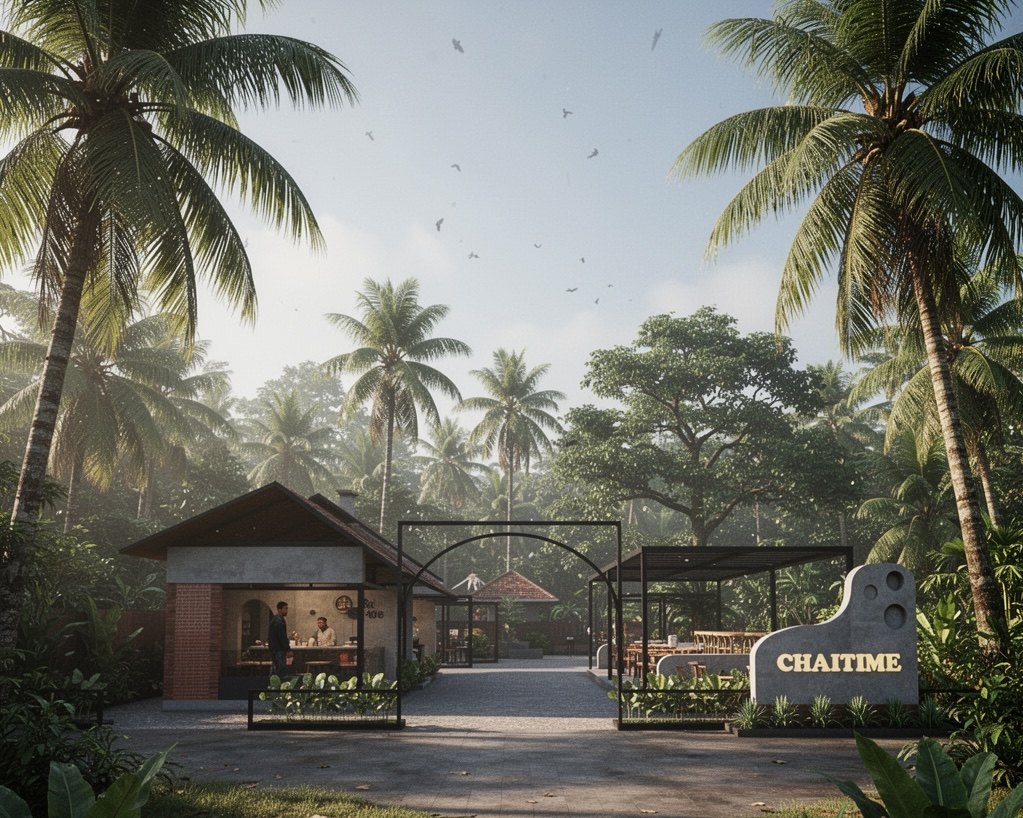
Outdoor seating in the Kerala climate.
Outdoor seating under trees or palms is one of the great pleasures of eating out in Kerala, but it has to cope with strong sun, sudden downpours and long monsoon months.
- Provide a solid roof or deep shade over at least part of the outdoor area, so it can stay open in the rain.
- Remember that monsoon rain often blows in sideways. Screens, blinds or a generous roof overhang help.
- Use ceiling or wall fans for still, humid evenings.
- Choose floors that drain quickly and stay slip-resistant when wet.
- Pick furniture that tolerates sun and rain, and that staff can stack or move easily.
- Keep seating clear of falling coconuts and fronds, and keep drains and planters free of standing water to limit mosquitoes.
Our guide to designing for the monsoon covers roof edges, drainage and materials that last outdoors.
Lighting, acoustics, finishes and licences.
Lighting changes how a place feels as the day goes on. Use daylight well, then layer artificial light: general light for cleaning and service, warmer focused light over tables, and accent light for the counter, signage or a feature wall. Avoid glare in customers' eyes and harsh light on food. Our guide to lighting design is written for homes, but the principles of layering and colour temperature apply here too.
Acoustics are often forgotten. Hard floors, glass, concrete and bare ceilings make a busy room loud, and noise drives away guests who want to talk. Soft surfaces help: acoustic ceiling panels, fabric, upholstered seating, timber slats with absorbent backing, and planting.
Finishes must survive heavy use, frequent cleaning and humidity. Choose:
- Floors that are non-slip, easy to mop and repair.
- Table tops that resist heat, stains and moisture.
- Wall finishes that can be wiped down in busy areas.
- Upholstery fabrics suited to heavy use and humid conditions.
- Fixed counters and storage in materials that do not swell or warp in the monsoon.
Licences and approvals. Opening a food business usually involves several approvals, which can include food safety registration or licensing, a trade licence from the local body, fire safety clearance, and others depending on the size and location of the business. Requirements change from time to time and depend on your situation, so confirm the current list with your local body and a consultant who handles these approvals. Your designer can help make sure the layout, kitchen and fire safety details support the applications.
Common questions.
How much space do I need for a small café?
It depends on the number of seats, the menu and how much kitchen equipment you need. A café serving drinks and light snacks needs far less kitchen than a full restaurant. Ask your designer to test a few layouts on the actual unit before you commit to a lease.
How do I plan the seating layout of a restaurant?
Start from the kitchen and service routes, then place tables so staff and guests do not cross paths. Mix table sizes so you can seat couples and groups. Leave enough space between tables for service and comfort.
What licences do I need to open a café in Kerala?
Most food businesses need food safety registration or licensing, a trade licence from the local body and fire safety clearance, with others depending on the business. Requirements change, so check with your local body and an approvals consultant before you start work.
What finishes work best in a restaurant?
Choose materials that are easy to clean, resist moisture and stand up to heavy use. Non-slip floors, stain-resistant table tops and wipeable walls are good starting points. Add soft surfaces where you can to keep noise down.
If you are planning a café or restaurant anywhere in Kerala, talk to us about your space and concept.